

This post may contain affiliate links. We may receive a small commission, if you make a purchase. Read Disclosure.
The Whitsunday Islands are most synonymous for its pure silica sand so white and powdery it’s like walking through snow, or swimming face to face with bat fish out on the Great Barrier Reef, but there’s a side to the Whitsundays that might surprise you.
The last thing you think of when you think of the Whitsundays are mangroves and silty water so dark and murky you’ll never have a chance of spotting the 4 metre croc holding its breath on the bottom of the river bed, patiently waiting.
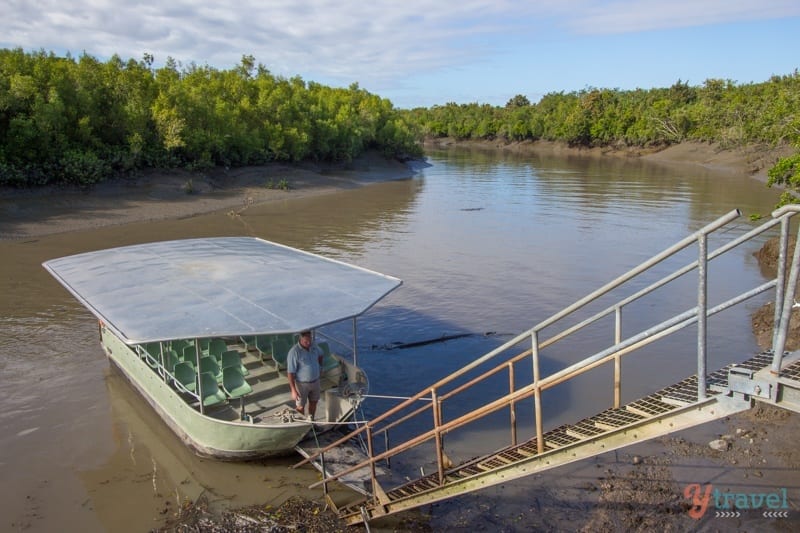
If you want to have a memorable experience that shows the other side to the Great Barrier Reef, then consider a Croc Safari of the wetlands of the Whitsundays.
This is a chance to see crocs up close in their freshwater wetland habitat, and since it connects to the ocean, you can see salties as well as freshies in the estuaries.
For wildlife lovers, this is the experience for you…
The Other Side of the Great Barrier Reef: The Mangrove Forest
The mangrove ecosystem is essential for the health of the reef. They trap sediments and absorb extra nutrients, and their complex root systems filter the water before it moves out into the ocean.
The roots slow the movement of tides and cause the sediment to fall to the bottom instead of depositing on the coral as the water moves past it.
The reef in turn buffers the heavy seas, which allow the mangrove forests to grow.
What a loving relationship they have!
Mangroves have never been high on the must-see list. At one stage they were so underrated in Australia they were ripped up and their swampy homes were turned into housing estates and cemeteries, and their natural inhabitants pushed out.
The damage we do when we don’t take the time to understand and appreciate the value every living thing holds…
Now we realise the importance of this unique tropical environment.
It’s like the small flowering plant our croc tour guide, Steve, told us about on the Whitsundays Crocodile Safari on the wetlands out the back of coastal Airlie Beach on the calm waters of Proserpine River.
In South America, there is a small rose coloured flower that are seen to be weeds, but this small little plant actually saves the lives of many in Southeast Asia who suffer the fate of a cobra bite.
Or the sandpaper fig, a flowering tree that many find to be pests growing in their back yards, yet to the indigineous people, it was like the greatest market in town.
They would pick their fruit from the tree, catch their meat by way of bats and possums that made it their home in it, and use the twigs for creating fire, and turn multiple parts of the plant into healing potions.
You see, it’s not just crocodile sightings that Whitsunday Crocodile Safari offers, it’s an educational experience…
Our Experience of a Whitsunday Crocodile Safari Tour
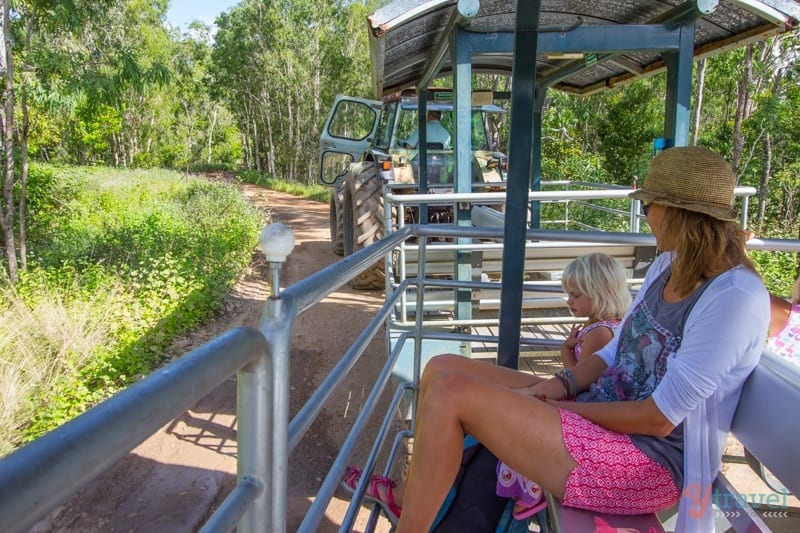
We were driving through the Goorganga plains in a tractor-drawn wagon train as part of the Whitsunday Crocodile Safari tour.
Steve, one of our local experienced guides, stopped as we drove along to talk about the native plants and vegetation growing in the flood plains that have gone under many times in the past 6 years.
It’s thriving ecosystem that many forget to experience, so fixated are they on the coral and sea life of the reef.
A reef that is totally dependent on the wetlands area we were just in.
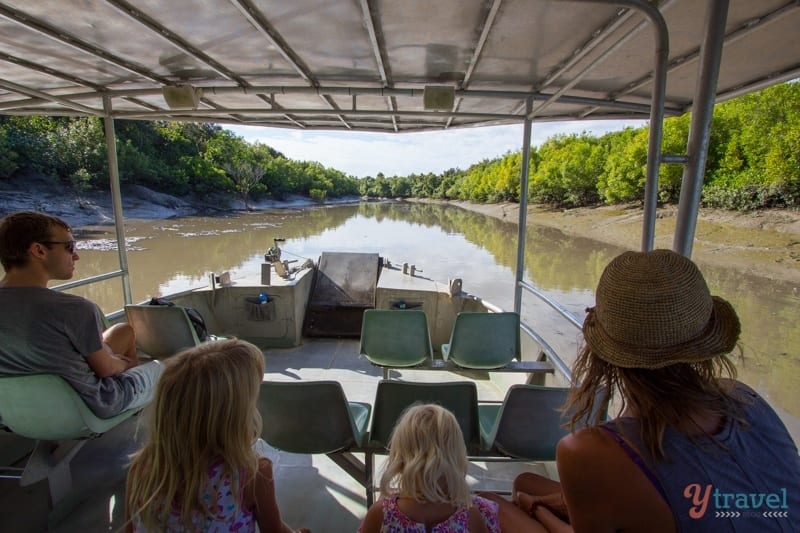
Earlier that morning we’d spent two hours motoring up and down the Proserpine River on a barge cruise.
It’s one of the healthiest rivers to support croc life on the Eastern seaboard, and the success rate that you will see a croc is about 98% – you can’t beat those odds!
Only the week before we’d had a fabulous education about the crocs at the Koorana Crocodile Farm. Now we were learning all about them in their natural habitat.
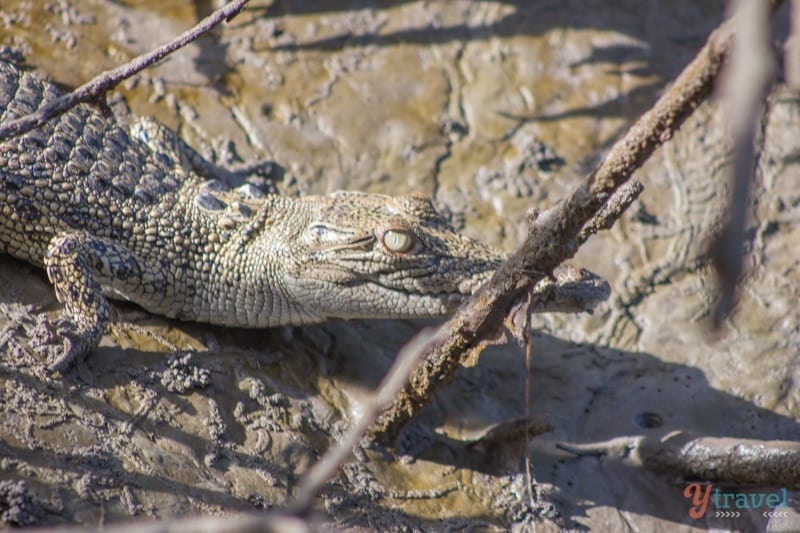
We saw hundreds of baby crocs sitting on the edge of the water on the muddy banks, sunning themselves on logs, or scurrying into the water at the sound of our approach.
Sometimes mum lay close by. Her body stretched out in the mud, her head comfortably down enjoying the warming of her blood.
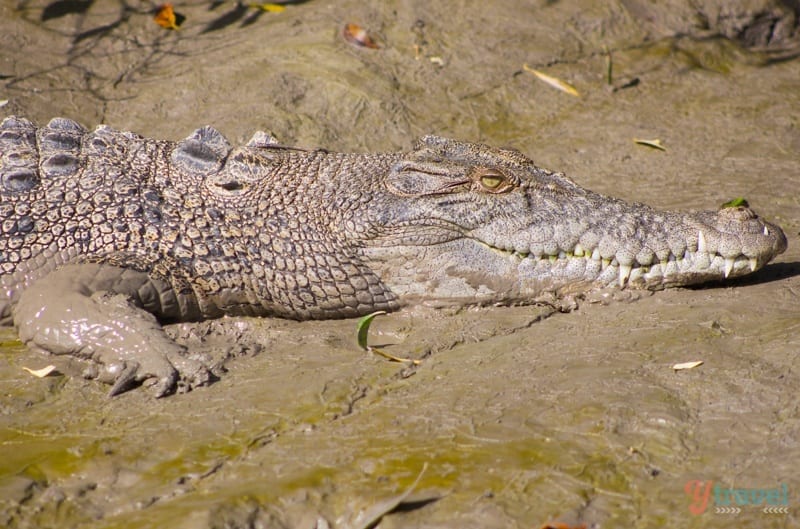
She barely blinked, so comfortable she was with the presence of our boat. Steve’s been running these tours for 20+ years, so the resident crocs know him well and don’t feel threatened by him.
We could get as close as you would want to get in the wild.
Steve told us it was extremely rare for us to see a mother so close to her babies in the wild and they generally abandon them after one month, but many of these little-uns were sticking close to mum even a year on.
The cruise was calming and relaxing, and we saw many migratory birds flying over head and sitting in the trees above the heads of these jurassic mammals, whilst listening to the professional expert commentary from Steve.
As we puttered along on our calm-water cruise, Steve picked out the crocs small and large from afar, calling them by name, baffling us as to how he could even see them, they were so well camouflaged.
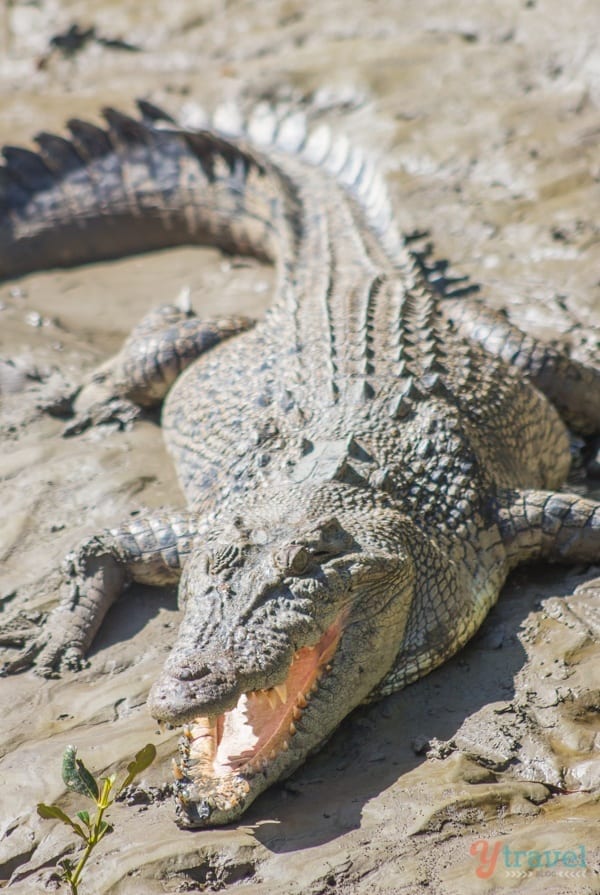
“When you’ve done it as long as me, you know them very well. I can tell each one apart from the other. What you don’t realize is that we’ve passed over about 10 – 12 crocs so far that you haven’t seen.”
Oh that made me feel slightly sick.
Crocodile Safety
Crocs are one of my biggest fears in Australia, especially knowing that my girls are with me. It’s hard to be so alert to make sure they aren’t sticking their hands over the side, or moving around or going anywhere near the edge.
They got the “this is serious” talk from me before we got in the boat. They were to sit in the middle and don’t move.
After Steve’s safety talk about how infested the river was with crocs and going in the water was not a smart idea ever, I think they got the picture.
It’s a shame many other people don’t.
Steve shared with us a few stories of completely stupid people deciding that testing their fate by out swimming the crocs was a fun idea.
One guy was bet $10 by his mate to swim to the other side of the Proserpine River and back. Just to see if he could make it without getting eaten. What an idiot. I wouldn’t even do it for a million.
OR the tourists who had slung their towels over the sign warning people not to swim in the croc infested river, so they could go swim in it.
As Steve said,
“People wonder why they get into trouble with crocodiles. And then idiot people like this cause governments to bring in laws to cull and kill to remove the threat of the monsters!”
He also shared a statistic that more people get killed each year by vending machines than crocs, sharks and snake attacks combined.
Vending machines?? Yep, apparently when people shake them and they fall on them they die. Who knew?
And in 90% of croc deaths, the victims had traces of alcohol in their system.
Not only did I enjoy seeing the crocs in the wild, at a safe distance, I loved the respect and love Steve had for them.
He had a name for each one and could tell us the story and temperament of each croc. There was Fish Lips, Fat Guts, Boof head, Dorothy and Pearl.
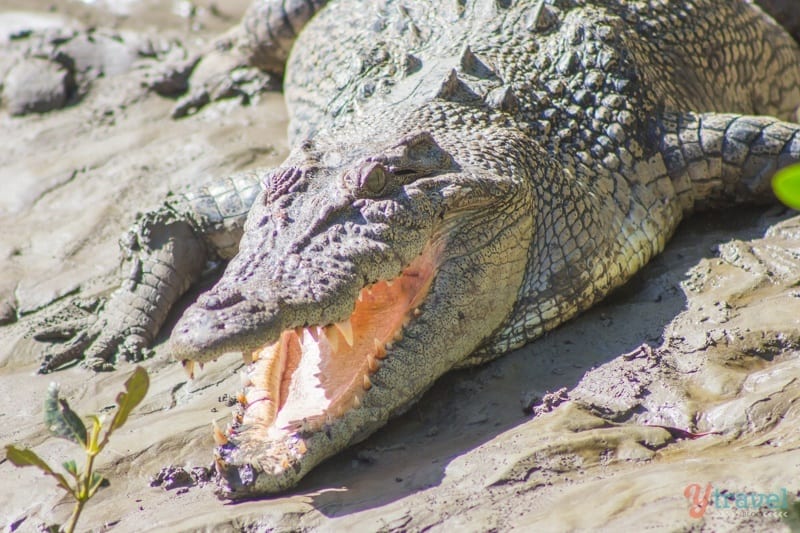
It made me feel a little attached to the crocs and I began to see them with new eyes.
Read more: Warning Australia is full of deadly animals
End with good tucker
The Whitsunday Crocodile Safari just doesn’t open up the world of estuarine crocodiles and wetlands for you, it also gives you some mighty good tucker.
In between the boat and the wetlands tour, we had a lovely barbecue lunch of sausages, steak, fish and chicken with lovely salads.
Then at the end of the day, enjoy a mug filled with the unique tastes of traditional billy tea and some damper and honey. Cold drinks are also available. It doesn’t get much more Australian than that. I tell ya, that was some good damper too!
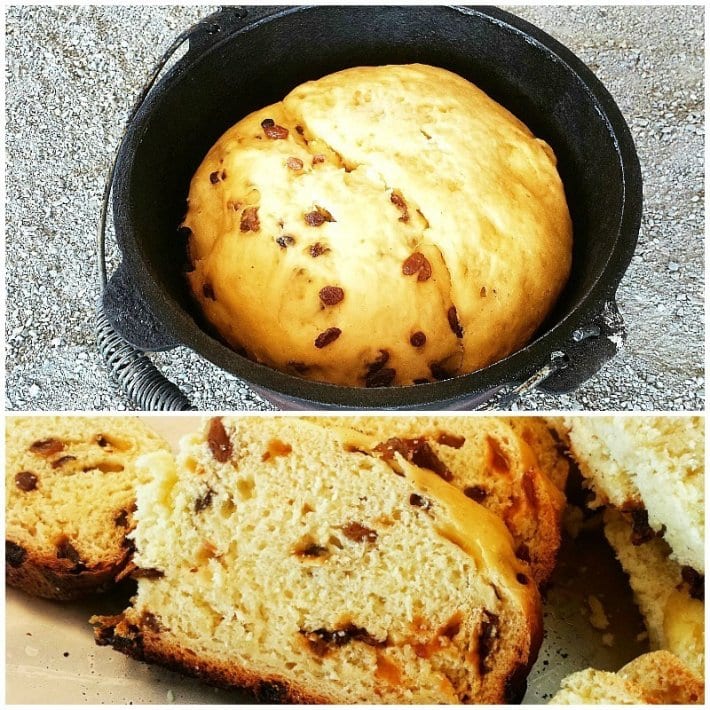
I enjoyed the crocodile safari and seeing a different side of the Whitsundays.
I don’t think you can fully appreciate the reef until you spend time understanding one of the reasons it’s so damn magical.
Go inland for a bit, get to know the wetlands, the mangrove river life, and the beautiful crocodiles that call almost half of Australia their home. It’s a great day out and a memorable nature experience.
Tips for Doing A Whitsunday Crocodile Safari
- Wear closed footwear.
- Bring a jacket for cool and windy days, as it can get pretty cold out on the water.
- Let the tour operator know in advance if you have dietary requirements so they can make accommodations for you.
- Bring a camera with a zoom lens, as many of the crocs are far away and you may need to zoom in a bit.
- Check weather conditions before booking, as you won’t see many marine animals on rainy days.
Whitsunday Crocodile Safari Details
Location: The Proserpine River is a short drive from Airlie Beach in the Whitsundays. Your full-day tour includes return transfers from Airlie Beach.
Tropical North Queensland Travel Tips
Thinking of visiting other parts of tropical North Queensland? Here are some other helpful guides…
- Amazing things to do in the Atherton Tablelands, Cairns
- Ultimate guide to driving the Savannah Way, Outback Queensland
- Go to Carnarvon Gorgee National Park if you want to see kangaroos
- 5 day itinerary for the Sandstone Wilderness
- Quick getaway to Great Keppel Island
- A Thrilling Tour of Whitehaven Beach
- 24 hours on Daydream Island resort
- A luxurious Intercontinental Hayman Island Resort
- Things to do in Townsville, QLD
- Why you should visit Agnes Waters and the Town of 1770
- 50 Stunning and adventurous things to do in Queensland
- Why haven’t I heard of Finch Hatton Gorge before
- Things to do at Cape Hillsborough, Mackay – kangaroos on the beach
- Eungella National Park, best places to see platypus in Australia
wow 90% had alcohol in their system- that’s a big number! I did some swimming in the Nile and guides assured us that no crocs were there because of close rapids, but I have a big fear of saltwater crocs. A friend of mine lost a loved one in the Andaman isalnds, snorkeling at a 5 star hotel, near a reservation for crocs with NO signs up warning them that some were in the area. Just out of the blue the croc snatched her away. Terrifying. A cove my boyfriend is working on a reef for in Mexico has saltwater crocs and I just hate they work near them.
Yeah, they completely scare me. Thats terrible about your friend. Anything that has lived for as long as crocs need to be feared. We swam in the Nile as well – our guide assured us but looking back we swam in a part that was really calm and quite away from the rapids. I don’t think we should have swam!
Glad to see that we’re conserving lands that we didn’t see the value in prior to today … there’s beauty in everything, you just have to find it!
Agreed Adam. Was a great tour and learning experience for us and importantly our 6 year old.
I’ve done this tour! Great to read about it through someone else’s perspective, and I thought this post was really well-written.
The average person loathes mangrove environments, but biologists and wildlife-lovers see it as pure treasure! Tours like this do great work getting members of the public on side with the idea of preserving these places.
Glad you enjoyed the bush train too – it would be easy for the crocs to hog all of the spotlight, but me and my travelling companions found soap trees, tree snakes and flood stories just as interesting!
Feel free to check out my original blog post on the tour:
http://wildbrisbane.blogspot.com.au/2013/09/north-queensland-trip-part-2.html
Definitely Christian. The guys at this croc tour do a great job at getting the message across. Glad you’ve had the opportunity to do this tour. Was interesting to learn about the other side of the Whitsundays.
Huh. Really had no idea there were crocs and mangroves in the Whitsundays, too.
Those crocs are cunning and lurking in more places than you think 🙂
i like pic
Man those crocodiles used to scare the hell out of me when I lived in Queensland as a child!
Being a huge crocodile lover, I have been to the Whitsunday Islands may times. In fact every time I visit Queensland, I always go there. The islands are a treat to all nature lovers, and Arlie beach is my favourite. One won’t find any crocodile on the Arlie beach; for seeing crocs one has to go to the banks of the nearby rivers. You can find many crocodiles in lying in muddy water on the river banks. But when you are busy seeing these dangerous predators relaxing, you must always be careful that you are safe from other crocodiles hiding in the wild terrain.
http://www.travelspec.com/
Love this. What a contrast to everything I thought I knew about the Whitsunday Islands. I just need to take a year and travel around Australia, it seems like such a diverse place.